Artemisia Gentileschi and Elisabetta Sirani, the women who painted female rage

(This is a historical account, but those sensitive to certain topics may want to sit this one out.)
On the morning of May 14, 1612, in a courtroom in Rome, officers of the court wrapped cords around the fingers of an 18-year-old painter named Artemisia Gentileschi and began to tighten them.
The device was called the sibille. Cords looped around each finger, drawn tight, then tighter, crushing the joints. It was a standard instrument of judicial torture, used to test whether a witness was telling the truth. The court was applying it to the fingers of a girl whose entire life, whose entire future, was in those fingers.
But she was not the accused. She was the victim.

The man who raped her sat in the room, untouched, watching. As the cords bit down, she looked at him and said, over and over, so the notary wrote it into the transcript where it still sits in the state archive of Rome 400 years later:
“È vero, è vero, è vero.”
It is true. It is true. It is true.
About 50 years later, 230 miles north in Bologna, a different painter set up her easel in front of an audience. Her name was Elisabetta Sirani, and she was the most productive artist in the city, so fast and so prolific that a rumor had taken hold among rival painters: no woman could work at that speed. Her father must be painting the canvases. She must be signing another man’s work.
So she painted in public. Visitors came from across Europe to her open studio to watch her work, and she would take a canvas from blank to finished portrait in a single sitting while they stood there watching her hands.

Two women, two generations apart, both facing the same accusation, which was never about art. It was the same sentence, spoken in a courtroom and in a rumor: a woman could not have done this.
One was forced to prove herself under torture. The other proved herself as performance, over and over, for her entire career.
This is a post about the burden of proof, and about what it cost each of them to carry it.
The Spirit of Caesar
Artemisia Gentileschi was born in Rome on July 8, 1593, the daughter of the painter Orazio Gentileschi. Her mother died when she was twelve. She grew up in her father’s studio, grinding pigments, learning the trade, and by her mid-teens she was better than most of the grown men in his circle. Her earliest surviving signed painting, a Susanna and the Elders was completed when she was about seventeen and already shows what she would become. Two men leering down at a naked woman, and the woman twisting away, her face not seductive but disgusted. It may be the first Susanna in the history of art painted from Susanna’s point of view.

In 1611, Orazio hired a colleague to tutor his daughter in perspective. The colleague was Agostino Tassi, a landscape painter with papal commissions and a moving cloud of scandal that trailed him from city to city. One day in May, in the Gentileschi home, Tassi pushed her into a bedroom, covered her mouth, and raped her. The trial transcript preserves her own account. She fought him. She scratched his face. She went for a knife and tried to stab him in the chest.
Afterward, Tassi promised to marry her, which in the brutal logic of 17th-century Rome was the only available repair for what he had broken, because what he had broken, legally speaking, was not her. It was her marriageability, which belonged to her father. She held him to the promise for months. When it became clear he never intended to keep it, Orazio went to the courts.
It is important to explain what the charge actually was. Tassi was not tried for what he did to Artemisia. He was tried for damage to the Gentileschi family honor. She was not the injured party; she was the damaged property, and she was also the chief evidence. And evidence, in a Roman court, could be tested.
The trial lasted seven months. Artemisia was examined by midwives in front of observers to verify her account of her own body. She was questioned again and again. And on May 14, 1612, she was tortured with the sibille while her rapist watched, so the court could be sure a woman’s testimony held under pain.

A painter. Cords crushing her fingers. And what she said, while it happened, was: it is true, it is true, it is true.
Tassi was convicted. His sentence was a choice between five years of hard labor and exile from Rome. He chose exile. It was never enforced, though. He stayed in Rome and kept right on painting frescoes for Pope Paul V, because he was useful, and useful men are forgiven everything.
Within a month of the verdict, Artemisia was married off to a Florentine and sent out of Rome, which was how a scandal was tidied. And this is where her story truly begins.
In Florence she painted Judith Slaying Holofernes. You have probably seen it, even if you don’t know you have. Two women, sleeves rolled, pinning a general to his bed and sawing through his neck with a sword, blood soaking the mattress in arcs. Caravaggio had painted the same scene a few years earlier with Judith standing daintily back from the work, mildly troubled. Artemisia’s Judith leans in. Her forearms flex. She is doing a hard job carefully. The painting is not a fantasy of violence. It is a portrait of competence, and the competence is the vengeance.

She painted Judith again. And again. Judith with the sword, Judith with the severed head in a basket, Judith pausing at a sound in the dark. Across her whole career she returned to the women who ended men: Judith, Jael with the tent peg, Salome. Art historians spent centuries clucking that her work was “influenced by her biography.” Yes. It was influenced by her biography the way a verdict is influenced by evidence.
In 1616 she became the first woman ever admitted to Florence’s Accademia delle Arti del Disegno, the professional guild of artists, in the academy’s 53-year history. Membership meant she could buy her own materials, sign her own contracts, travel without a male guardian’s leave, and exist, legally, as a painter rather than as some man’s daughter or wife. She worked for the Medici. She worked in Rome, in Venice, in Naples. She went to London in her mid-40s to paint for Charles I alongside her aging father. Her patrons included kings, and she still had to fight them for payment letter after letter, because patrons routinely tried to pay a woman less, or later, or never.
In 1649, near the end of her working life, she wrote to a Sicilian collector who was shaking her down: “You will find the spirit of Caesar in this soul of a woman.”
She died in Naples in the mid-1650s, probably in her early 60s, possibly in the plague that swept the city in 1656. The record thins out at the end and does not say. She was buried in a Neapolitan church under a stone that reportedly read, in full, Heic Artemisia. Here lies Artemisia. The grave was later lost. The only verses published to mark her passing were two satirical epitaphs mocking her, not as a painter, but as a woman with a scandalous past. Not one word about the work.

And then, for nearly 300 years, the erasure. Canvas after canvas of hers was attributed to her father, or to lesser men, because collectors and scholars looked at the power in the paint and reached, once again, for the old standby. A woman could not have done this. Modern scholarship has spent the last half century clawing her catalog back, painting by painting.
The envious hand
Elisabetta Sirani was born in Bologna on January 8, 1638. Her father, Giovanni Andrea Sirani, had been a favorite pupil and chief assistant of Guido Reni, the most celebrated painter in the city’s history. Bologna was, by the standards of the age, the best city in Europe to be born a talented girl. It had a centuries-old university tradition of learned women, and it had already produced successful female painters. Not equality, nowhere near it, but a crack in the door.
Her father trained her, along with her two younger sisters, though a family friend later claimed Giovanni had to be talked into it. She was painting professionally by 17. And then gout crippled her father’s hands, and everything landed on her.

She took over the family workshop. She became the breadwinner for the entire household: parents, siblings, students, all of it carried on her commissions and teaching fees. And she produced. In a career of roughly a decade, Elisabetta Sirani turned out around 200 paintings, plus hundreds of drawings and a body of etchings. Portraits, Madonnas, altarpieces, heroines from history. She could finish a half-length portrait in a single sitting. Empresses and grand duchesses commissioned her. Bologna called her the second Guido, the heir of Reni himself.
Which is precisely when the sentence came for her too. No woman paints that fast. The father must be doing it.
Her answer was the open studio. She painted before audiences, before nobles and travelers who came specifically to watch, canvas to completion while they stood at her shoulder. She turned the burden of proof into theatre, and she won. Nobody who watched her work ever repeated the rumor again.
But what that meant was that she had to prove her own work was valid. Her rivals were not asked to prove their canvases were their own. Her speed, in a man, would have been simple genius. In a woman it was evidence of fraud until performed otherwise, live, on demand, for years.
She did something else with those years, and it may be the most important thing she did. She taught. Sirani opened her studio to women and ran what amounted to a school for women painters, training somewhere over a dozen of them, aristocrats and tradesmen’s daughters alike, at a time when no academy in Europe would formally train a woman. She was building the thing she had never had: a room where a girl could learn to paint without a father in the trade.
And she painted Timoclea.
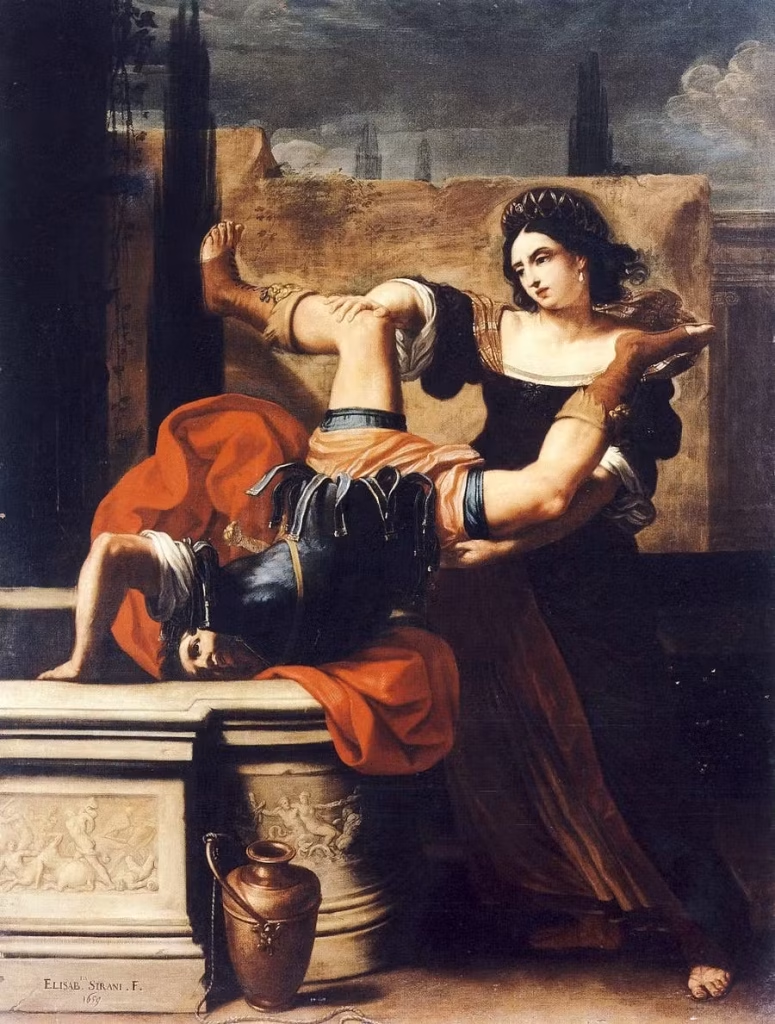
Timoclea, in the ancient story, was a woman of Thebes raped by one of Alexander the Great’s captains. Afterward, the captain demanded to know where her money was hidden. She led him to a well in her garden, told him the treasure was at the bottom, and when he leaned over to look, she pushed him in and heaved stones down on him until he stopped moving.
Painters before Sirani who touched the subject painted the aftermath, Timoclea brought bound before Alexander, dignified in defeat. In 1659, at 21 years old, Elisabetta Sirani painted the push. The captain upside down, boots in the air, halfway into the well. Timoclea above him, braced, both hands committed, her face perfectly calm.
Artemisia painted Judith with the sword. Elisabetta painted Timoclea at the well. Two generations of women who had been required to prove what men are presumed, and both of them, when handed a canvas and a choice of subjects, painted a woman finishing the argument.
In 1665, Elisabetta began suffering waves of savage stomach pain. She worked through the. In late August she collapsed and died. She was twenty-seven years old.

The family physician examined her and declared corrosive poison. Suspicion fell on the maid, Lucia Tolomelli, who had quit the household days before. The girl was charged and tried for murder. The case fell apart; and her father eventually withdrew the charge. Modern historians, reading the recorded symptoms and the autopsy notes describing her ulcerated stomach, mostly agree on the more mundane, but no less tragic, verdict: a perforated ulcer, peritonitis, death by the workload itself.
The weight of carrying an entire household, a workshop, a school, and the standing obligation to publicly prove, again and again, that she was real.
Bologna gave her a funeral fit for a prince. On November 14, 1665, the church of San Domenico was hung in black and gold for a civic funeral of a kind normally reserved for statesmen. At the center stood an enormous catafalque built as a Temple of Fame, and on it, a life-sized sculpted effigy of Elisabetta at her easel, brush in hand, painting. Music was composed for her. Orations were read. Among the funeral emblems hung one that stops the heart: a fruitful tree with an axe laid to its trunk, over the motto Invida Manus.
The envious hand.
Her city knew exactly what it was burying and exactly what had felled it. They laid her in the tomb of Guido Reni himself, the master beside the second Guido, and a poet mourning her called her the Lamented Paintbrush.
È Vero
So here it is, the crux.
Rome tortured Artemisia and let her rapist keep his papal commissions. She answered with a 40-year career, a guild membership no woman had ever held, and a lifetime of Judiths. And her reward was a lost grave, two sneering epitaphs, and three centuries of her paintings attributed to men.
Bologna, the gentlest city in Europe for a woman with a brush, merely made Elisabetta prove herself in public for her entire adult life while she fed her whole family on her output, and the output helped kill her at twenty-seven. Only then did the city weep and bury her like a head of state.
Those were the two viable options, and they were offered to the two best women painters of their century. Proof under torture or proof as performance. Cords on your fingers or an audience at your shoulder. There was no option where the work simply spoke and was believed, because the presumption never changed. It is true, it is true, it is true, said under the sibille. Watch me, watch me, watch me, said at the easel.
The evidence was never going to be enough. Believing women was never going to be enough. How little the world has changed.
And yet, 400 years later we read Artemesia’s voice saying it is true and we believe her. The paintings survived, and one by one they are being attributed correctly. Elisabetta’s students went on painting, and the school she built outlived her, and her Timoclea hangs in a museum in Naples where you can stand in front of it today and watch a calm woman push her rapist down a well forever.
The envious hand took what it could, but itt could not take everything. It never does.
Say their names with rage in your voice. Artemisia Gentileschi. Elisabetta Sirani. It is true, it is true, it is true. Say it over and over until the whole world believes it. Push them into the well when they don’t (I’m saying metaphorically, but you do you). And for all that’s holy, do not let them take your spirit, your talent, your spark. Paint your rage, write your rage, scream it from the rooftops. Because maybe, someday, in hundreds of years, or today, someone will see it and say, it is true.
Truth is contagious, and we need to spread it.
Thanks for reading!

If you like our work, please subscribe, share, and post freely! You can find us on Threads, where we post a different thread about women in history most days. Or buy us a coffee, all proceeds go to research and funding this site.
Announcement about our book is coming soon, watch this space, or subscribe to be the first to know!
Leave a Reply